
Mumbai could be swallowed by the sea. BMC begins a fresh risk check
10866322 mumbai 1600
- ✓10866322 mumbai 1600
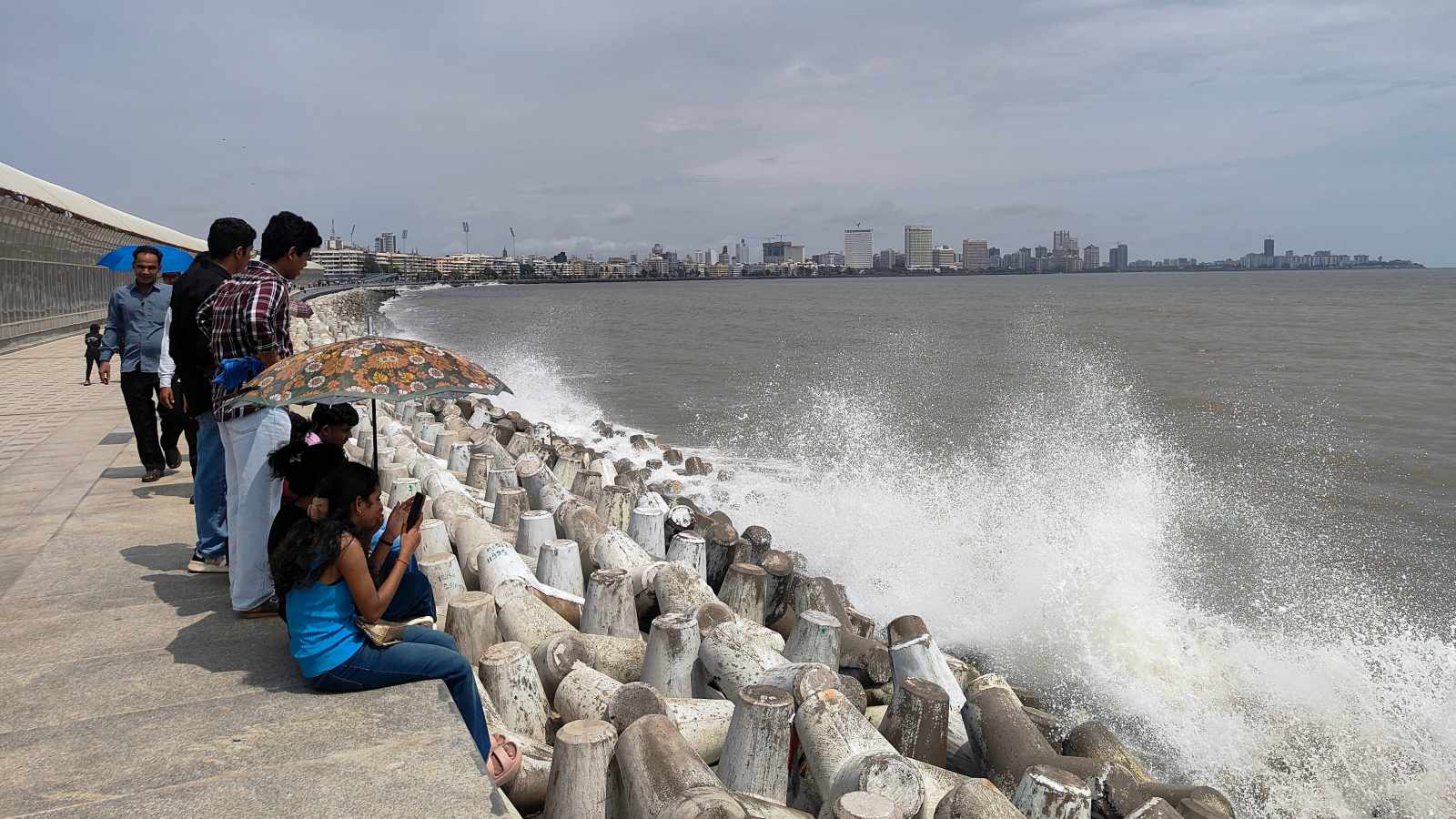
- ✓The Coastal Road has come up along the western seafront, with more than 100 hectares of the Arabian Sea reclaimed.
- ✓It had also projected that 80 per cent of Mumbai’s island city could be submerged by 2050.
- ✓The 2022 MCAP noted a steady increase in SST in the Arabian Sea over two decades.
With Mumbai facing the prospect of permanent inundation from rising sea levels by the end of the century, the Brihanmumbai Municipal Corporation (BMC) has commissioned a fresh assessment of the city’s vulnerability to sea-level rise, its second such exercise in five years.
The new climate-risk assessment, currently underway, will map vulnerable stretches along Mumbai’s 149-km coastline, identify inhabited areas at risk and assess how changes in land use, coastal development and climate patterns have altered the city’s vulnerability.
The report is expected to be released next year. The move comes against the backdrop of a recent United Nations report warning that global sea levels rose by a record 5.9 mm in 2024 and projecting at least 0.5 metre of rise by 2100 even under aggressive emissions-reduction scenarios.
Under a worst-case scenario involving instability of the West Antarctic ice sheet, the rise could be as high as two metres. “Over the last five years, Mumbai’s shoreline has seen a massive transformation. The Coastal Road has come up along the western seafront, with more than 100 hectares of the Arabian Sea reclaimed.
On the eastern side, salt pan lands have been identified for development. There has also been a change in the overall land-use pattern. Therefore, a fresh risk assessment was needed,” the official said. Unlike the UN assessment, which looks at sea-level rise at a global scale, the BMC study will focus specifically on Mumbai.
It will examine local factors contributing to coastal vulnerability, project future sea-level rise and identify populations living in areas adjoining the shoreline that could be at risk. The BMC’s first Mumbai Climate Action Plan (MCAP), released in 2022, had identified coastal flooding, rising pollution, loss of green cover and increasing urban heat as key climate risks facing the city.
It had also projected that 80 per cent of Mumbai’s island city could be submerged by 2050. Scientists have linked the rise in sea levels to global warming and increasing sea surface temperatures (SST). The 2022 MCAP noted a steady increase in SST in the Arabian Sea over two decades.
“While the analysis of annual mean SST between 2003 and 2020 shows an absence of a statistically significant trend in sea level variations, a slight steady increase of 0.025°C per year for daytime SST and 0.019°C per year for nighttime SST has been observed,” the report stated.
Raghu Murtugudde, emeritus professor at the University of Maryland and visiting professor at IIT Bombay, said warming across Europe and West Asia was also contributing to higher temperatures in the Arabian Sea. “Over the past few years, we have seen rainfall patterns becoming more erratic, with Mumbai recording above-normal rainfall.
Heavy rainfall and high tidal waves are working as a combined factor leading to inundation of Mumbai, posing a heavy risk to people living in the island city,” he said. Roxy Mathew Koll, oceanographer and climate scientist at the Indian Institute of Tropical Meteorology (IITM), said Mumbai’s geography itself made it particularly vulnerable.
“Rapid development, concretisation and land-use changes shrink floodplains and congest rivers. The Bandra Kurla Complex was built on mangrove land, while the Mithi River was reduced to a nallah due to roads and encroachment.
Mumbai floods are more of a management problem due to unplanned development rather than a climate change problem,” he said. Koll said protecting mangroves and coastal wetlands would be critical to improving Mumbai’s resilience.
“Mangroves and floodplains have traditionally acted as the lungs of the city, protecting it from flood water and strong winds. Protecting and expanding these coastal wetlands can significantly enhance Mumbai’s resilience to sea-level rise while providing safe habitats for biodiversity and marine life,” he said.
The MCAP had recorded significant changes in Mumbai’s mangrove cover between 2008 and 2021. According to the report, 325 hectares of dense mangrove cover had either become sparse or been converted into intertidal mudflats because of erosion and sedimentation, while density had increased across around 305 hectares.
Pratip Acharya is a seasoned journalist based in Mumbai reporting for The Indian Express. With a career spanning over a decade, his work demonstrates strong Expertise and Authority in critical urban issues, civic affairs, and electoral politics across Eastern and Western India.
Expertise & Authority Current Role: Journalist, The Indian Express (IE), reporting from Mumbai. Core Authority: Pratip's reporting focuses sharply on local democracy and development, specializing in: Urban Governance and Civic Affairs: Providing in-depth analysis of municipal decision-making, city planning, and local infrastructure, essential for informed urban reporting.
City Politics and Environment: Covering the political dynamics of Mumbai and surrounding areas, alongside critical environmental challenges impacting the metro region. Electoral Coverage (High-Stakes Experience): He has extensive experience in high-stakes political reporting, having covered major elections, establishing his Trustworthiness in political analysis: National: Lok Sabha elections in 2014 and 2019.
State: West Bengal Assembly elections in 2016 and Maharashtra Assembly elections in 2019. Major Assignments (Ground Reporting): Pratip demonstrated commitment during crises by conducting ground reporting throughout the Covid-19 pandemic since its breakout in 2020, offering first-hand accounts and analysis of the public health crisis.
Experience Extensive Experience: Starting his career in 2014, Pratip has built his foundation across multiple prominent English dailies: Started at The Times of India in Kolkata (2014). Relocated to Mumbai (2016) and worked with The Free Press Journal and Hindustan Times before joining The Indian Express.
Pratip Acharya's diverse experience across major publications, coupled with his specialized...
- •Aspirants and citizens are advised to monitor official notices and circulars issued by Maharashtra State Bureau (Mumbai).
- •Verify all prescribed eligibility criteria, cutoff dates, and authenticated document requirements prior to formal submissions.
- •Track connected examination timetables, vacancy advisories, and administrative gazettes on SuchnaSetu.
| Issuing Authority | Maharashtra State Bureau (Mumbai) |
|---|---|
| Topic Category | STATES |
| Jurisdiction | MH State |
| Publication Date | 7 September 2026 |