
Gujarat Hardlook | Long shadow of West Asia War: Why ‘made in Surat’ garments could be 30% costlier this Diwali
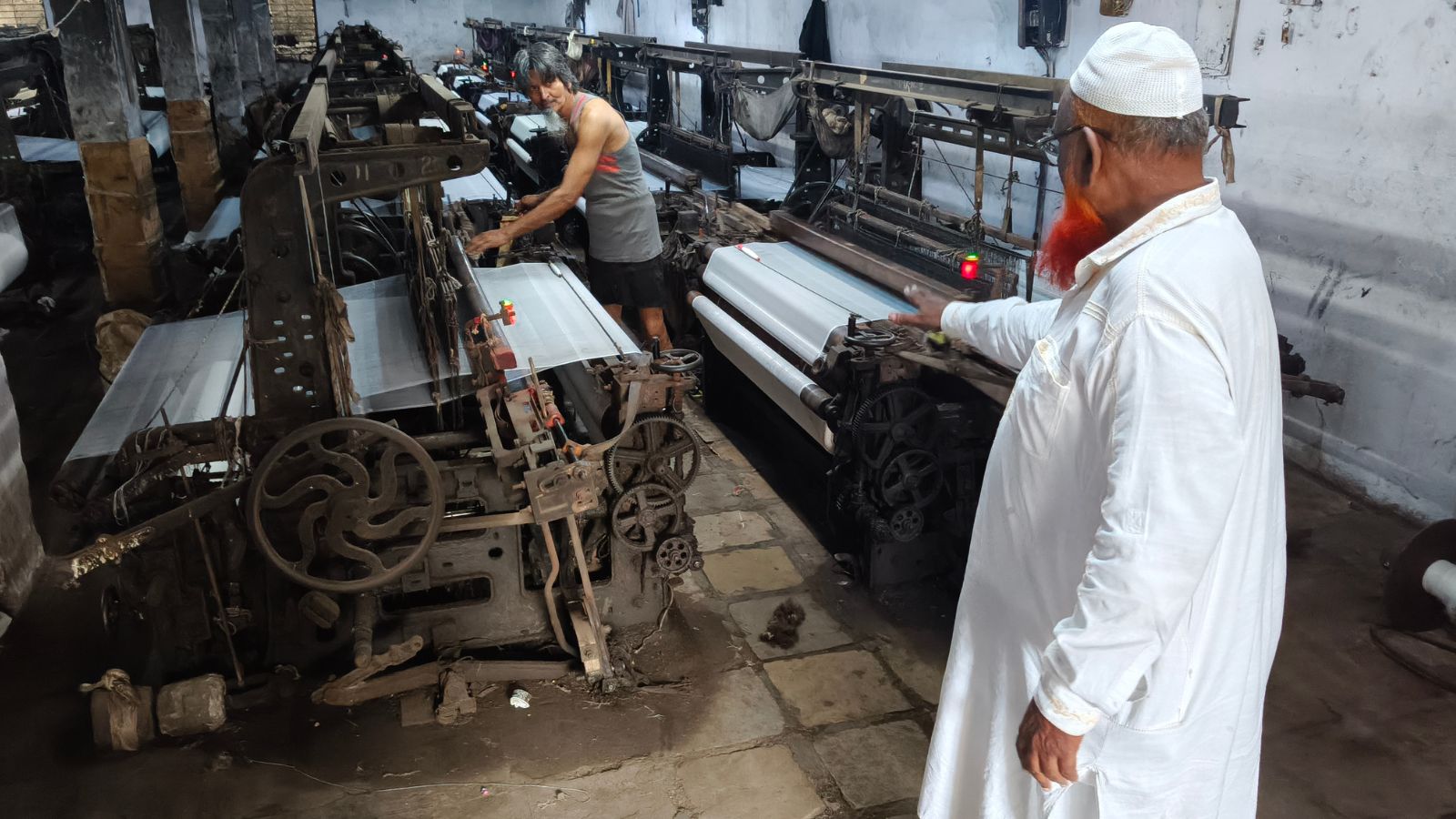
10866416 surat (5)
- ✓10866416 surat (5)
- ✓A total of 25 workers keep the operation running.
- ✓Dakshin Gujarat Vij Company Limited (DGVCL), the state power distribution company, raised tariffs from Rs 7.30 a unit to Rs 9.15 a unit this year.
- ✓Producing a 120-metre bale of unprinted fabric requires about 3,700 kg of partially-oriented yarn (POY).
At Govind Nagar Industrial Estate in Surat's Udhna suburb, home to more than 500 powerloom units, Kesarali Peerzada has been running a textile weaving unit for nearly 25 years. His factory, Mallika Textiles, is in a ground-plus-two building where he keeps watch over the shop floor from a part-wood, part-glass office, backed up by CCTV cameras across the shop floor.
The unit houses 48 powerloom machines, along with machines for twisting yarn into thread and a warping machine that threads yarn through small holes to form a beam, which is then fed into the looms to produce grey (unfinished) fabric.
A total of 25 workers keep the operation running. “These workers don’t have local documentation and were dependent on the black market for their supply of cooking gas. When the gas containers ran short and prices went through the roof, they migrated to their native place and returned a month later, during which our factory remained shut.
Before the gas shortage, we were paying Rs. 1.80 a metre (of fabric woven) to the labourers, and after they returned from their native place, they demanded a salary hike, and we are now paying Rs 1.95 a metre”, says Peerzada.
Peerzada, a commerce graduate, says, “Even though crude prices have actually eased from a wartime peak of roughly USD 120 a barrel to around USD 95, the price of POY (Partially Oriented Yarn) hasn't followed suit — it remains stuck around Rs 180 per kilogram, up from the Rs 140-150 range it was earlier” .
He attributes this partly to the fact that yarn pricing in India isn't overseen by any regulatory body but controlled by a “cartel involving big players”. Adding to this was the cost of power to run the mills. Dakshin Gujarat Vij Company Limited (DGVCL), the state power distribution company, raised tariffs from Rs 7.30 a unit to Rs 9.15 a unit this year.
The squeeze runs both directions: while costs for yarn, labour and power have all climbed, buyers further down the chain, the textile traders, who get grey fabric dyed and printed, have resisted paying more, insisting on old rates.
Peerzada says, Some traders understand and adjust, but increased competition has actually pushed the price of grey fabric bales (roughly 110 metres each) down slightly, from Rs 13 to Rs 12.80 per metre. Producing a 120-metre bale of unprinted fabric requires about 3,700 kg of partially-oriented yarn (POY).
Kunwarlal Verma, 42, moved to Surat from Pratapgarh, Uttar Pradesh, two decades ago and has worked at Peerzada's factory for the last three years, while his wife and two children remain with his parents back home — his father, a farmer with a small landholding, supports the family alongside Verma's two younger brothers.
Verma sends home Rs 12,000-15,000 a month to cover his children's education; His daughter is finishing Class 12, while his son, a recent graduate, now works at a private firm in Ahmedabad. Verma said, “Here, we work and stay in a rented room and cook for ourselves.
Due to the LPG shortage, I went back to my hometown and stayed there for two months. Before the crisis, I was getting around Rs. 22,000 per month. The salary depends on production. Earlier, we were getting Rs. 1.80 per metre.
After my return, I demanded more, so the owner increased it by 15 paise per metre, and now I am getting Rs 1.95 per metre. The salary depends on the work done as per production. Daily we are getting Rs 700 to Rs 750 per day.
We get one day off a week, and if I work on off days, I get paid extra." He shares a small rented room with three other workers in Limbayat, splitting the Rs 2,000 monthly rent equally, and commutes by bicycle for roughly 15 minutes.
Verma says his priority is his children's future—he has pushed his son toward competitive exams for banking, railway or state government jobs, hoping to spare him the hardships he has faced. “I work in 12-hour shifts which sometimes extend to 36 hours if my reliever does not show up for two consecutive days.
Earlier, I used to go home once a year, but for the last few years, I go twice: on Holi and Diwali. I don’t spend money here in Surat; I save it for my children. One of my brothers runs a samosa shop in my village, while another helps my father in the fields.
I miss my family, but I have to compromise as I am the only earning member of the family. Every day before going to work and after returning back home from duty hours, I talk to my wife and children,” says Verma. Compounding pressures further, the Southern Gujarat Textile Processing Association (SGTPA), representing roughly 400 dyeing and printing mills in Surat, met on August 28 and announced a 15 per cent increase in charges for processing unfinished fabric, effective September 7.
This raises the cost traders pay to get grey fabric dyed, cleaned and softened by about Rs 1.50 per metre, on top of the existing Rs 10-15 range. SGTPA president Jitubhai Vakhariya linked the hike to the jump in coal prices (over the year) driven by Strait of Hormuz disruptions affecting imported supplies from Indonesia.
Mills rely on coal-fired steam, generated at high temperature, to fix dyes and chemicals onto fabric, using a roughly 60:40 blend of lower-grade lignite and higher-calorific imported coal. Monsoon-season restrictions on lignite mining have pushed mills toward greater reliance on the more expensive imported variety — its calorific value nearly double that of lignite, says Vakhariya.
Vakhariya said imported coal prices have risen by as much as 50 per cent since the geopolitical situation changed in February, following the Iran-Israel-US war. He says (non-coking) coal prices rose from around Rs 6,000 to Rs 9,500 per tonne, with individual mills burning 30-50 tons daily.
The hike has not gone down well with traders who are a critical link in the supply chain. The Federation of Surat Textile Traders Association (FOSTTA) met on September 2 and rejected the increase outright. Secretary Dinesh Katariya argued that the SGTPA acted unilaterally without first...
- •Aspirants and citizens are advised to monitor official notices and circulars issued by Gujarat State Bureau (Ahmedabad).
- •Verify all prescribed eligibility criteria, cutoff dates, and authenticated document requirements prior to formal submissions.
- •Track connected examination timetables, vacancy advisories, and administrative gazettes on SuchnaSetu.
| Issuing Authority | Gujarat State Bureau (Ahmedabad) |
|---|---|
| Topic Category | STATES |
| Jurisdiction | GJ State |
| Publication Date | 7 September 2026 |